It's no secret, I'm a Nvidia fan, but disregarding that I say Google needs to buy Nvidia. Nvidia would give Google a strategic advantage in pretty much every part of their company. Here's a list of reasons why I think Google needs to buy Nvidia.
Google uses computers a lot
He's Using a Computer too
The obvious thing is that Google uses computers a lot. All of their employees have laptops, cell phones, some have desktops, and the company has servers that they use to handle request from billions of people each year. If Google is able to produce the computer GPUs for their employees, servers and mobile devices they would all together spend less money.
Nvidia's servers easily outperform Google's
Incredibly powerful server tech
Just recently I read an article stating that Nvidia in conjunction with Stanford developed a neural network that surpassed Google's with merely 16 servers. Sure you may see that as a whatever thing, but keep in mind that Google used 1000 servers for their neural network. That's a big difference. Nvidia's methods are cheaper than Google's and more power efficient. Nvidia's GPUs has up to 3000 cores within them. Basically each core can be used for parallel computing, therefore the server is able to add another 1000 processes into a server with ease.
Google already is producing phones
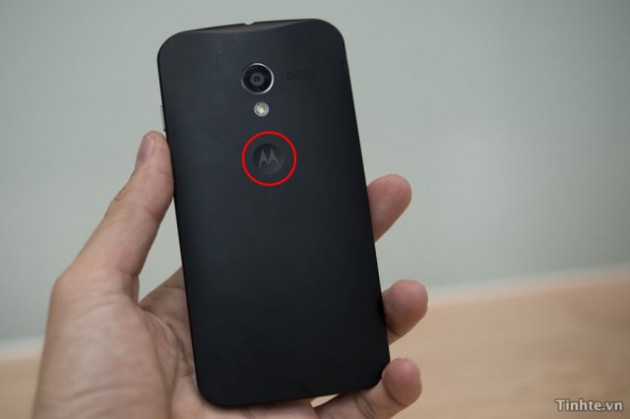
The Moto X
Google is already producing phones with their consumer hardware company Motorola. They've recently been emphasizing on GPUs for their products, and Nvidia happens to be very good at it. Also, if Google creates phone processors custom tailored to their devices, they would have a greater deal of perfection within their devices.
Nvidia is filled with computer hardware geniuses
Looks fun to work there
Google is made of software geniuses, while Nvidia is filled with hardware geniuses. I can fairly say that Google has been pretty bad at creating low leveled software. Since Motorola became part of the company, Google has been able to speed up Android's kernel development by a lot. It shows off with the performance and battery life increases with Android 4.3. With Nvidia, they would be able to advance low level software further and faster compared to before. When you see things like DirectTouch coming from Nvidia, you really begin to see how far these Nvidia can go. Google needs to get a piece of the action.
Can quickly design chips for anything
If Google has an idea, they can easily get a chip designed between Motorola and Nvidia in no time, prototype a device with the chip they design, make quick modifications, and deploy products much faster than any of their competition (until you look at Samsung).
In the last two days I had a stroke of genius - okay, maybe not genius, but still good - and I have come to the conclusion that he Android operating system could actually turn out pretty well inside of a laptop. It could get to the point in which it competes with the likes of Mac OSX, Ubuntu and Windows, which hasn't happened yet with any other operating system. I'm not just saying it will because I love Android, which I do and I'm sometimes pretty bias, but I considered many different components from all sides of the "Computer Spectrum". Here are my list of reasons why the Android OS could be "the Killer Laptop/Desktop OS":
Software
It's Linux based
Android originally began as a major fork of the Linux kernel 2.6. For those of you on android that don't know what a kernel is, fear not. A kernel is the bridge between the physical hardware and applications. Windows uses the word "driver", which is why most people have not heard the term before. Below is a diagram of the structure of android. Never mind the green, blue and yellow sections, focus on the red. If you look, you'll see a number of drivers that are in the kernel to help the hardware connect to the overall operating system.
If you're like most people, you're probably asking "Where are you getting at?", so allow me to explain. Well, Linux is the fastest moving operating system in the world. According to the video here, Linux has on average 8000 developers developing the operating system collaboratively from all over the world, from multiple companies each year. This means the kernel is changed every few months instead of every few years like with Mac OSX and Windows. This also means there's less issues in the operating system, because usually people will fix a problem and send a patch to the creator and the people in his office for widespread change. With it's support, Linux has brought some features most mainstream OS's haven't implemented like 3D printing and compiler changes that would make the OS snappier and use less memory.
While Android's kernel originally began as something drastically different due to the quest of keeping the OS small, Android is now going back to the mainline of the Linux kernel as it has proven to keep the performance up while making sure the resources used are low. The "K Release" , also rumored as Android Key Lime Pie, will likely introduce an almost fully merged Linux Kernel, which will create the opportunity for the OS to add a massive amount of features that you'd find from Ubuntu, Debian and Red Hat. This means you'd be able to add plenty of compilers (mostly like more a versatile GCC) on the android laptop/desktop OS. IDE's, and other special development tools for programmers can be imported to the Android operating system. That would make the tech guys pretty happy.
Android So Far...
So far, Android has been able to reach a deeper sleep than it ever has with the latest release, Jelly Bean 4.3. Before now, Android has had a problem reaching a deep sleep, which is why it ran hot people's pockets. It's also one of the main reasons manufacturers needed to place massive batteries into their phones compared to the iPhone where the battery is extremely small. The latest android introduced a few other modifications like security, and performance increases.
Android 5.0
Android 5.0 is when Android reaches practical perfection. The operating system is supposed to be able to be used in many different configurations like in Google glass, watch, and even laptop like form. The entire theory that Android will soon come in laptop form came from analyst reports. This OS will have many internal modifications for speed and battery purposes just like 4.3 brought. 5.0 will be ever closer to a fully functional linux laptop OS in no time.
App And Developer Support
Android is known for it's wide selection of applications. As I'm writing this blog, there has been 806676android apps added to the market.An Android Laptop will have at least 50,000 of those apps within the first year or two. With chrome for android, Android will have a unified experience between laptops, web browsers, and other mobile devices.
Gaming
Nvidia's Shield
Facing the facts, Android has a robust game developer support. It could get to the point where it can compete with Windows. Seeing they are now working on solid multiplayer API, and Nvidia's Tegra graphics are getting to the same point as the PS3, I think Android laptops and Gaming systems can compete directly with Xbox and Sony's Console.
Floating Apps and Windows
One true advantage mainstream OSs like OSX and Windows have on Android is Window multitasking support. We've seen with Facebook Messenger that Android can have applications that sit on top of each other, and Samsung has proven that Android apps can be viewed side-by-side too. Android has the capacity for full window support as well. I think Google will implement full window support into Android 5.0 to allow the OS to compete with big league Desktop OSs.
Hardware
No matter what form of common hardware you use (ARM or x86), Linux and therefore Android will be able to run on it, the Motorola Razr i is a good example of how x86 architecture works with it. ARM is on 95% of android phones to date, therefore there's no need for further proof that it works with ARM.
Outside of the basic architecture, ARM has a wide array of designers and manufactures that could make the chip's architecture go viral. Here is a list of unique processors that could bring it's technology to Android.
Nvidia's Kepler GPU
Look at the tessellation. So cool
Nvidia's Kepler GPU technology is truly a very efficient technology. Compared to most other GPU technologies, the ARM Kepler is said to outperform every mobile GPU technology by up to 5 times while using around 1/3 of the power. Now I've been looking at the special details for this, and I couldn't find anything extremely specific. I did, however, find a bit of info about Kepler graphics in general.
Mobile graphics will make a major leap in the next year
How Kepler Works
Dynamic Parallelism vs Conventional
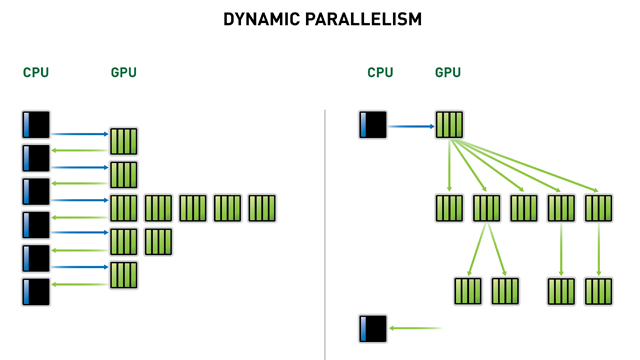
The main goal of Kepler chips is to reduce the work load of your CPU. The common CPU/GPU model requires the GPU to send a response every time an action takes place. Sure it works, but it could be a lot more efficient by requiring the GPU to respond less while still getting the sane amount of work completed. To do this Nvidia brought a couple of parallel computing concepts into their Kepler GPU. The first is Dynamic Parallelism, the second Hyper-Q, the third GPUDirect.
Perfect Graphic Control
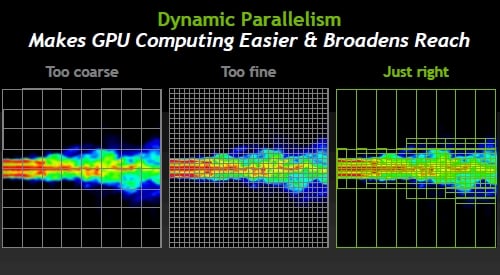
Dynamic Parallelism allows one GPU core to send processes to other GPU cores without having to send a signal back to the CPU. Therefore the CPU is able to reduce the load taken while completing graphic intensive operations. The GPU is also able to do calculations where the based only on what moves much more efficiently.
Hyper-Q allows each CPU core to complete work on the entire GPU at the same time. That allows the GPU to work at full potential all the time and reduce the latency of the CPU. I particularly love this, as this means the processor can finally compute graphical information to the fullest more efficiently.
GPUDirect enables the GPU to directly make transfers to other 3rd party devices. This means devices such as SSDs or NICs (Network Interface Controllers) can transfer information almost instantaneously, which is why Nvidia technologies can be used with cloud computing. This technology can also allow for other clustering/parallel technologies like insanely powerful mobile peer-2-peer technology or using SSDs to cache large sets graphic information instead of normal mobile disk. The download speeds can greatly be increased too, as downloads are directly connected with the NICs. You'll notice that nvidia's shield has powerful download speeds. Some is contributed to MIMO Wifi, some is also contributed to a slight integration with this technology. Hopefully Nvidia uses this to the full potential.
Here's a picture of Ira
He's so Cooooool
Nvidia's technology can make the phone in the next 12 months up to 5x more powerful. While many people reading this blog are probably annoyed that I haven't talked much about other people like the creators of PowerVR GPUs, or Qualcomm's Adreno, but understand I've looked at them both and they didn't impress me enough to focus on. That's mostly because while they will provide powerful graphics, they won't be as efficient as Nvidia's Kepler technology. Qualcomm's Adreno technology won't be licensed out to other chip designers either, making them slightly less relevant in 2014 as the main players in the smartphone business now want to design their own chips.
Motorola's X8
The X8 Chip
Motorola's new X8 processor impressed some, didn't impress others, but it certainly impressed me. The new chip is meant to have the usual dedicated CPU and GPU within the chip, but they introduced a concept I personally didn't think would come about. They made a special core for each natural language and sensors!
I feel some of my readers probably don't care all that much about this feature, and call it bluff, but there's a reason it's the exact opposite. This setup is very similar to the way our brain works. Our brain has something called the Limbic System. While we have the frontal lobe which does allows us to use logic and reasoning skills, the parts in the Limbic System and other lobes control other important functions: memory, speech, emotional responses, cognition, body regulation, visual perception, color recognition, spacial orientation, touch and information processing. The mere fact that they now have specialized cores for specialized task means that they can grow ever closer to a human like robot.
So, the CPU is like the frontal cortex and the GPU is like theOccipital lobe, which is responsible for visual perception and some processing . The Natural Language Chip would be a lot like the speech processing part of our brain, the auditory cortex, and the new sensor chip is much like the Thylamus, which is responsible for registering and transmitting senses within our own brain.
You can probably see where the Motorola X8 is going now. It's heading to the point of having a chip/core for each dedicated task. I had no idea Linux had this type of capability within it's kernel, but now I see it does, I can't wait to see what this will bring about.
Adapteva's Parallella Cores
It's coming!!!
Parallella uses the same concept of Nvidia's GPU parallel processing, only they increase the number of CPU cores instead of GPU. The CPU cores run in parallel in order to increase the speed of certain compilations. As of now, Linux barely supports parallelism within small processors. Usually parallel processing is only found within GPUs and within multi-million dollar super-computing systems. The video below shows the computing difference when parallel CPU processing is utilized.
Skip to 1:05
Android will be a killer Laptop system because it will be able to run smoothly and implement the best parts of hardware and software well before other mainstream operating systems do, much like how normal Linux does. With all of the above Android would seriously be one Killer Laptop OS.
This is a 5 minute microblog article I'm writing prior to the Q2 earnings. It's more of a checklist, but I don't think that matters. Google might not reach Q2 expectations. Here's why:
So this week has been glorious. I've had to do massive amounts of work therefore I didn't have a lot of time to make my post. The Title of the blog post implies that this is to be the be a Nexus/Android/Google blog, but you'd notice that my last post was more about the web itself and it only included the topic of Android and Google inside of it. This post will specifically speak about technology as a whole. Sure it will include a few Android devices, but the focus will be on the consumer devices as a whole. These are a few trends I've noticed in the last few weeks in the technology world. The trends suggest what the next big thing is.
The cell phone world will use technology from other parts of the tech industry
I have no idea why I didn't think of this before, but since I read the news article, In One Big Nudge, Google To Spend $500 Million To Market Moto X Phone - Report, I became consumed with the thought that Google was nudging the practice of bringing already established technologies from other parts of the tech world such as car like monitors, Kodak "clearpixel" cameras for low light photography and dual channel LTE for up to an average of +50 MB/s into the mobile tech industry. This could mean devices wont be entirely concerned with beefy processors, screen sizes(and pixel density), but more concerned with introducing new technologies to change the experience of phones. Nokia and Samsung have done similar things until now, each bringing something like NFC with Samsung (and all android), and new camera technologies(like 41 pixels for extreme digital zoom and image stabilizers) in Nokia devices. The Moto X might be the main drive to take the integration of foreign technology from other industries into the mobile industry.
Getting to the last 5 Billion while making the world better
This presentation gave me a good idea of how the time around 2020 will be for the 3rd world country with mobile technology. This failed to even mention any advancements to cooling, agriculture, metal extraction, medicine, 3-D Printing technology, or other revolutionary technologies that I haven't thought of. But generally speaking, the message is all pretty clear. Companies are investing into the final 5 billion people. Investing in emerging markets cost relatively little but usually have high gains after a while. Just think of how the banker J.P Morgan originally invested in the US's Electrical, Steel, Oil and Railroad systems and you'll see exactly what I'm talking about. Nokia's introduction of the Asha 501 devices, and how Google is expanding 3g like wireless service to almost the entire world via Project Loon are key indicators that they are indeed taking emerging markets seriously.
3-D Printing Is Not a Fab, it's One of the Main Biggest Things
I want to make everything clear. 3D printing is far from a Fab, it's gonna go mainstream. You can really tell because Organizations like GE and NASA are investing into it, and NASA especially doesn't waste money. I have a story of my own to prove how inefficient our current process is. About a year ago I entered the racing car development club in my college for the hell of it. No, I'm not some dude who loves cars, I don't fantasize about have a Mercadez when I grow-up, I want a car that will run on something like 10000000 miles a gallon -I have my dreams. As I said, I joined, but only because I was bored, and I quit after the first week. It was all cool designing the car, but the process for making all of it's parts was unbearable, and the people there were extremely rude and antisocial, which I thought was annoying. People's personalities aside, let me tell you how the parts were made in a step-by-step format:
Find out what piece we have to make.
Look at all the measurements
Figure out what machines to use
Figure out the specifications for creating the piece
Shave the piece to make it look as smooth as required for the car(By hand)
Drink a quarter gallon of water to prepare for one long ride
Get a spot at the machine you need
Get the pieces necessary for the machine
Begin taking an extreme number of measurements so you can make a precise first cut/drill/saw
If You mess up, start from step one again and skip step 6 if an hour hasn't already gone by
Use measurements from the sheet and check for accuracy continuously and keep going to until you can go no more.
Done? Probably took 3 hours of your life for that one piece, if you have special machinery for this the process took around 1.5 hours.
If you messed up, start from square one again. Make sure you enjoy step 6 or add an extra step for flirting, because if you don't you're gonna have one hellish night.
The process for mass production is not too different either. It goes a lot like this:
Engineers look at the design
They determine the dimensions of the parts
Create a machine for each hole, curve from a specific block (Takes forever to design)
Create special machines for special processes, like for moles and special sprays (Also taking forever)
Generate massive amounts of waist from excessive drilling and shiming of metals and heat to cool things. (Not very effective)
I feel like I'm missing little details too, which is a shame. Basically I could call the club "Build one part for 2 or more hours" club, because that's what we were doing. Designing the car took only two weeks, but building it like this took about 29 weeks. Even though the Mechie kids building the car had massive amounts of pride in the car, I thought that with Future Technology, 3-D Printing, the club could have had 6-7 cars up and moving in the time it took for 1. My point is, 3-D printing technology will make this type of situation almost disappear. Just imagine having one machine do all the work for you in any material by creating the part in a CAD program then just sending it in. Car and plane manufacturing could be speed up by 10 to 25 times the norm, the manufacturing price would be reduced for most items including some micro-electronic parts, and people could make anything mechanical in their garage in their backyards.
They say in the NASA article that 3-D printing cut it's production cost by 70% and shaved off months from the time used. Just imagine what could happen in cars, boats, planes, electronic (and microelectronic) parts, computing device shells(laptops, cell phones etc) and more. This technology can go widespread fast, and will mean everything will be cheaper for everybody in the world. Because everything will be so much cheaper for the general population, printing technologies go hand and hand with targeting the Final 5 Billion, which is a section from earlier in the article.
Wearable technology
Wearable technology goes completely with my previous article, which I hope explains well on why wearable technologies are so important, even if Google Glass is not the most successful thing out there. They will connect with the beginning of the Web 4.0, which should let nerds rejoice.
Quantum Computing, That's right it's coming
Quantum Computing is insane. I'm not just gonna let you take my word for it, take this evidence. Quantum computing in the realm of research will allow humans to discover things that we never would have in no time flat. Generally speaking Quantum computing devices will replace Supercomputers by allowing you to do insanely complicated analysis that would take current supercomputers thousands of years to complete in seconds. Imagine the results: People could become Superheroes by figuring out
which genes will give people powers, we could design warp drives in a short period of time to get us from one Galaxy/Nebula to another in mere seconds, learn many of the properties of the universe faster than before, control gravity to prevent(or create) black holes, find medicines that could cure cancer, create AI that would be more human and intelligent than us, the list is infinite.
What These Technologies Mean
These technologies are just the tip of the iceberg, but they do mean a whole lot. Here's what these technologies mean.
To The Consumer
Prepare to have insane products from all over. Cars may only cost $100 if they're not flying by then, plane rides will only cost $10 with the 600 person plane only costing up to $1m for production, smartphones could be $3 dollars, and food prices can be reduced significantly with just 3-D printing alone. Quantum technologies could increase out scientific discovery by up to 1,000,000 times the normal and bring about new AI systems. Meaning we could live into the thousands (would be boring after a while) and increase our overall intelligence beyond what we've ever had. The standard of living will be like our own or better in emerging nations. Companies that invest in the last 5 billion will become ever wealthier, and that wouldn't hurt you one bit. You could also see 3-4 processor cellphones(like the 3 processor Moto X: Sensor processor, main CPU, GPU) sooner than you think.
To the Investor
The average investor will be very busy for the next 5-10 years. They'll need to find the next big companies that will represent the next big things. Forget app developer fabs, people representing these technologies are the ways to go. I plan on joining the investment gang in about 3-4 years after I get out of college, these are the first things I'm going for. If you are an investor, you can make tons of money.
So after an amazing response from the post Why I'm More excited for Key Lime Pie than Moto X, I decided to write a new post for the tech community's enjoyment. This Post is direct and somewhat thought provoking. I hope you all love it. :D
Artificial Intelligence? Yaay!!!
Everywhere you go you'll see Google doing something crazy with computing. It could be something like Artificial intelligence /w Neural networking or getting you information as you need like Google now or a Self-Driving Car too. Most of you Google fans see these technologies as cool, and they are, but if you look you'll there's a common pattern to their wacky & revolutionary inventions, which is to bring about the age of Web 4.0. Web 4.0 is basically the point when people and machines have a symbiotic relationship with each other. Coming together as one is another way to explain it. Computers on a network will assist people with everyday work.
What about Web 3.0?
If you're like me, you'd first think about Web 3.0 first, because I almost skipped the stage. While not enough people have openly used the term Web 3.0 in popular tech news, it's already alive and strong. So let's look at the characteristics of Web 3.0:
Website or Web Solution
Which we already use for everything
Mobile
Like Android, Windows Phone, or iOS.
Universal
All over the world in as many mediums as possible.
Accessible
Available anywhere at any time. Similar to universal
Individualized
filtered and shared by friends or trusted source
Efficient
Contextual information accessible at anytime
This will be the biggest thing out there
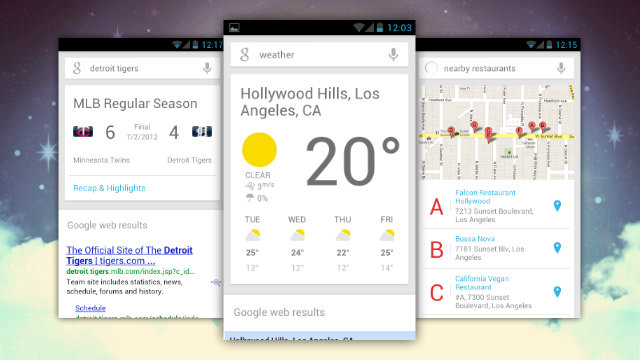
The biggest forerunner of Web 3.0 is Google's Google Now, an application that's supposed to be a lot like a personal assistant for the average person. It monitors what the person does on an average day while giving assistance to each individual. It supplies information like traveling back home or to work from a specific location, your favorite sports team results as the game is happening, the weather condition in your location, or even when your flight is going to leave and a online boarding pass to go with it.
Full Scale
The truth is, Web 3.0 is soon to hit full scale within the next year for the US. It's to go even further in two years. There are actually signs listed below, all of which are from Google, that point to the fact that a full scale Web 3.0 is actually coming, and Google will dominate it:
Android
Check out the market share
It's no doubt that in terms of market share Google is the reining champ. Because Google has 75% market share, they are more able to get their services to more people w/ less resistance, which includes their main medium the web (chrome). But it's not just them, they're also able to get their software to other platforms like Apple's iOS devices. Apple devices are a major source of profit for Google, as iOS users use their devices more often than most users from any other platform.
This adds to the universal part of Web 3.0
Google Now
Screenshot of Google Now
Google Now is a key indicator that Web 3.0 is to come along faster than earlier predictions. With Google Now, you're able to get the information you need as you need it, meaning it's contextual. The algorithms Google uses also are able to predict what you need before you request it with ease. I usually use their functionality to get information on bus schedules, stock information and weather on-the-go. What's more is that Web 2.0 social services are perfectly joined into this. Google+ birthdays and important events appear as I need it. Behavio, the old human tracker company now purchased by Google will definitely add a new spin to the application.
Internet everywhere
Google is making sure that internet will be going everywhere with their new projects Project Loon and mid-orbit satellites. This is surely an effort to get cheap, widespread yet effective service to places all over the world, then have them join Google's network. This will allow people in undeveloped nations to finally connect to the internet for the first time. With such connections, they have more advertisements worldwide, and people are able to produce more using data they never had access to, therefore both them and Google could increase overall revenue by a lot. They can also receive more data for contextual products like Google Now. With this the criteria of universal accessibility will be even further extended.
The Moto X
This is the Moto X
After Google purchased Motorola Mobility, and word got out that they would keep the hardware side of the company, rumors starting coming saying Google and Motorola would create a golden device, which eventually became coined as the X Phone by Droid-life's Bionic. Around the end of May this year, the device was confirmed for the first time as the Moto X. Dennis Woodside, Motorola Mobility's CEO stated that the device would be a contextually aware device. It will likely extend the capacity of Google Now beyond our imagination. It certainly makes a device efficient and more contextually beneficial. When you include the fact that Motorola has been advertising their Google now capabilities non-stop, you'll find it hard to deny that one of Moto X's missions is to take Google Now to the max.
Android "K Release" A.K.A Key Lime Pie
This version of android is supposed to solve the problem of fragmentation, and allow for cheap, well-running devices to be some around the world using the android operating system. More people on the newest OS = More on Google Now. It's plain and simple. The accessibility instantly part of Web 3.0 instantly becomes greater. My previous blog post explains why I think I'll like the new Key Lime Pie. Instead of explaining that, I'll just point you to that post.
You're gonna love that key lime pie
Other 3.0 Info
More Efficient API
If you look at the latest Google developer conference. You'll see that they were to
ting a lot about incredibly efficient Maps API for Android and new back end cloud systems for the average Android app so data can be transmittable and accessible everywhere with ease. They'll soon add predictive technology for the all Web Services and Android Applications. I have no proof on that last claim, but I can certainly bet you on it.
What Web 3.0 means for developers
Because Web 3.0 will be here full-fledged in a guesstimated 9 to 15 months, It means you developers will have no lives by the end of the year. You'll be stuck at your computer upgrading your product to stay current and ahead of the game for consumer's enjoyment. Fear not, by next Google I/O Google might have a solution for you to do it with ease almost like Android's Easy Cloud Function. On a serious note. Developers will probably start paying attention to automation inside of their apps. Many applications will utilize live information based on contextual information. Things like location based changes, phone distance from face, or maybe a wink from the person in front of the front facing camera. Really any contextually aware services that people can imagine will be more frequent in the coming year alone. And developers will play a key role in making sure that happens. Looking at the bright side, Android fragmentation might be reduced with the next Android release "K release".
Credit to Dayne Reast
Where Photo Technology Fits In
Last Google I/O, Google was talking a lot about using camera technology with Google+. I bet you didn't know that Google also has an amazing photo search technology. Hopefully with the use of 3.0 technologies, photo quality and the use of those photos for everyday search will be twice as amazing as it is now.
Now About 4.0
You're probably thinking, "That's Amazing! Now what about the original topic, Web 4.0?" So Web 4.0 is explained earlier as a platform where people and computers pretty much become one with each other. While so far there's not a clear definition of web 4.0 there's at least a small criteria to it, which are:
Artifical intelligence (computers with synthetic intelligence to resemble humans)
Ambient intelligence (better described in a list)
embedded: many networked devices are integrated into the environment
context aware: these devices can recognize you and your situational context
anticipatory: they can anticipate your desires without conscious mediation.
Do they seem familiar, because they should? Google has been easing this concept to people slowly but surely using Google Now and their Google [x] projects on artificial intelligence and more.
Here's a little about Google[x]
From Marques Brownlee
Wearable Computers
Next Gen Wearable Technology
The "Grade-A" platform, Web 4.0, has already been slightly introduced without you knowing. When Google Glass first came into the world this especially became so. Now the product can see as you can and use AI technologies to assist human beings in new ways computers have never been able to before. With the wearable shoe, and smart-watches coming out, I can predict that eventually almost everybody
will be okay with having such technology integrated into their everyday lives, just as we have for every commercial technology until now.
The self-driving car
The self-driving car is the transition from Web 3.0 to web 4.0. It's predicted to hit mass audiences in 2016 once it's been tested and tried in multiple legislation. I'm betting the companies Kia and Hyundai will be the original testers for the service. They seem more eager to use Google's services. This type of car will probably be contextually aware. There's no telling what else will be part of this car, well just have to wait and see.
The Way We Game
Web 4.0 is going to change the way we game. A key example is the game Ingress. It's a contextually aware game that uses GPS sensors to play. I can only imagine the new ways Google will introduce their technology to further extend the very interactive gaming experience.
Conclusion
So that seems like pretty much everything. As I have said, Google seems to be heading toward the path of Web 4.0. Inside the tech world things change rapidly, and so will the definition of Web 4.0. What do you think Web 4.0 will be about, and how do you think modern technologist will bring it about to the world. I want to know your options about that.
Feel free to leave questions, comments or suggestions. Oh, and I'm looking to find a new name for my weekly post. A name that's fitting for all of the tech world, and something that's says trend setting as well. I want you the community to make some suggestions.
This type of article is an occasional thing. Every month, I will make a new article like this about android an post it to the internet.
Two exciting (maybe revolutionary) things are coming from the android community in the upcoming months:
Android 5.0 aka Key Lime Pie
Motorola X phone (Moto X)
Both are to be great, revolutionary products. I will speak about both of them, but I want to state why I'm more excited about Android 5.0 KLP.
Moto X
This seems like the Moto X based on FCC reports too
I personally think the Moto X, a widely distributed phone from Google's child company Motorola Mobility, will bring some new concepts to the table hardware wise.
Defending the Rumored hardware
Rumors are coming in stating the device will be a dual-core Snapdragon processor with 2 GB of RAM and a base of 16GB of storage, believed to be expandable. Seems there's second processor inside to control the components of the device to give the phone extra battery life. Sure this seems seems unimpressive in this year's line of devices (competing with devices that have 4 - 8 cores), but in reality this actually still has a chance to wipe out the competition. I know what you're saying, "Dual-core porocessor defeat a quad-core or octo-core processor? That's retarded." I would like to teach you why it's not. After doing some research, I found out how you could realistically determine speed with certain devices. On wikipedia(Which is a good source) I found this:
QuickPath Interconnect frequency specifications
QPI operates at a clock rate of 2.4 GHz, 2.93 GHz, or 3.2 GHz. The clock rate for a particular link depends on the capabilities of the components at each end of the link and the signal characteristics of the signal path on the printed circuit board. The non-extreme Core i7 9xx processors are restricted to a 2.4 GHz frequency at stock reference clocks. Bit transfers occur on both the rising and the falling edges of the clock, so the transfer rate is double the clock rate.
Intel describes the data throughput (in GB/s) by counting only the 64-bit data payload in each 80-bit "flit". However, Intel then doubles the result because the unidirectional send and receive link pair can be simultaneously active. Thus, Intel describes a 20-lane QPI link pair (send and receive) with a 3.2 GHz clock as having a data rate of 25.6 GB/s. A clock rate of 2.4 GHz yields a data rate of 19.2 GB/s. More generally, by this definition a two-link 20-lane QPI transfers eight bytes per clock cycle, four in each direction.
The rate is computed as follows:
3.2 GHz
× 2 bits/Hz (double data rate)
× 20 (QPI link width)
× (64/80) (data bits/flit bits)
× 2 (unidirectional send and receive operating simultaneously)
÷ 8 (bits/byte)
= 25.6 GB/s
Edit: I have just been notified by a reader that the model about speed is wrong. Arm chips are more affected by clock speed than Intel's chips are. Krait architecture is so good, that the chips can clock at a higher rate than most others, therefore they more likely to move faster. Again, later on I state something about ignoring the intel part. Ignore that and QPI, that's an Intel specific bus.
So I know what you guys are thinking this looks like random crap thrown on a screen, but trust me it's not. Despite the Intel title, there's a formula that's pretty much the same no matter what processor you look at, which is for the data flow rate. It's a rate that pretty much determines the overall speed of the processor. As you can see, number of cores isn't the only part of the picture here. There are things like the bit/Hz rate, QPI link, which is size of the bus (The link between the CPU, I/O ports, and the memory) on the processor and the bit rate (android runs 32) are all more important than the number of cores. The number of cores are there to amplify the speed by 40% - 60% per core. The model explains why no two dual-core processors are equal, it's because inside the processor more things are present than just the number of cores. Plus the Nexus 7 problem is a good indicator that ram quality is still a very important factor.
That and if Motorola was able to convince Qualcomm to place one of their(Qualcomm's) best GPUs in a dual-core processor, you're looking at a device that could easily outperform the competition.
Contextually Aware device
The device is also supposed to be contextually aware, meaning you can take your phone out of your pocket and instantly snap a photo because the device will initialize the camera for you, saving you seconds of time. This seems like something a Google employee thought of. Maybe because they were annoyed with the current process of the device.
Extreme Battery Life and Build quality
I'm not the first to say that Motorola is amazing with the quality of their devices. I still have the old Droid Bionic, and I have been able to throw the device around without it breaking. After getting my hands on all their devices there after, like the Droid Razr, Razr HD, Razr Maxx, I can firmly state that they have the best build quality out of all the manufacturers, including Apple and their iPhone. Their Battery-life has also been amazing too, with the longest life I've seen is 3 days on the Droid Razr Maxx, something difficult to reach with almost any other smartphone.
Everything better
With the good build quality, things like camera quality and the screen are supposed to be amazing. I really don't have much of a comment on that, but I can only hope that this is true.
All of the above explains why I can't wait for the Moto X. I firmly believe it will be the best device of the year, with a reduced price because their parent company, Google, will likely subsidize them. I can hardly wait. I now want to state why I'm more excited for KLP.
Android Eating a Pie
Picture from a Googler
Key Lime Pie
Key Lime Pie is supposed the be the pentacle Android OS that nerds have been looking forward to for a long time. And they have a reason to be excited.
Design
With the introduction of Google Now a new style of android apps have come about called the Card Style. So far, we have seen this lighter than Holo style take over in applications like Google Play Music, Google Drive, Gmail, Hangouts, Google+ and even the Play Store. I think Google is going to revamp their design to this lighter happier style in the KLM addition of Android. Being a front-end User Experience Designer like I am, I have to say that I'm very excited for this. But there's more.
More Project Butter
In 2012, Google released their device with project butter. Project butter is the project that is meant to give the android OS a constant 60fps, and help resolve the lag in the devices as much as possible. While they did a phenomenal job, the lag is still there. I'm expecting project butter to be extended to near perfection in with this release. I think they will reduce the memory of the OS using the linux kernel 3.8, then give extra memory to the graphics end which should greatly help the smoothness of the OS. I love smooth animations, if they can make things smoother than they are, I'll be super happy.
Project Roadrunner
Remember Project Roadrunner? Well the project was first conceptualized by the Android community to solve the problem of battery-life in 2012 before the launch of Android 4.2. Sadly it didn't come to be, I think however that they will make some move towards that point. I only believe this because I saw a patent that seemed to make steps to resolve the issue here.
I'm sure there will be more modifications to the than what's in the link, like Bluetooth 4.0 LE or better Wifi radio performance, but the patent is the first clue that Project Roadrunner may soon exist. The Second Nexus 7 also has a smaller battery than the original, Project Roadrunner could be reason. Remember this mostly my thoughts right now, take this with a grain of salt until the tides of the technology world shows more.
Solving Fragmentation
KLP could take 80% of the android chart
Let's be honest, trying to develop an app for hundreds of devices at one time is difficult. It's even more difficult when you're trying to create a OS for a bunch of different devices. So much that even Apple, a veteran company, has a problem doing so, which forces them to keep their OS closed and just sell a lot of one type of phone. Google has managed to do it somehow, but they generated a bit of fragmentation over the years. Gingerbread still holds the largest share of the green pie (See what I did there?), compare to iOS, where most of the users are on the most resent version. While more people have Jelly Bean than ever before, most people haven't enjoyed that Jelly Bean goodness. Based on reports from VR-Zone, a Singapore tech news site, Google looks like they are to bring those on ICS on board, and maybe even some of the people on GB. Froyo and Eclair are both a lost cause, sorry you two. They say that the new version of android should be able to run on just 512MB of ram, which is barely possible with 4.1 Jelly Bean. Letting this OS run on weaker hardware should make an opening for phones to perform well for a cheaper price. This could allow for the end of fragmentation and allow manufacturers to focus less on heavily powered hardware and more on quality and brand, which should help bring profits up for more manufacturers. It should also give power to the low and mid end cell phone market, meaning everybody in developed countries will have an amazing device for the cost of $50 - $100.
Contextually Aware Hardware Support
Just as Google brought NFC with their Galaxy Nexus in Android ICS and that spread, I think they will add support for contextually aware hardware. This would make sense, when you consider that Motorola's CEO Dennis Woodside did state the features will be in their device, why wouldn't Google want the feature to be in all devices with their OS. I don't have much proof for this one, but I think Android devices with contextually aware hardware seems to follow trends. If I can buy a device from a different manufacturer with contextually aware hardware support, I would be very happy.
More Google Now Integration
So you know how Apple tots more siri integration? I'm thinking Google will add a personality to Google Now (almost like how Siri has one) and integrate it throughout the system. Perhaps it would be used with the contextually aware hardware. This would be cool since I already use voice commands for simple things like writing short post to Google+ and Facebook, or telling my phone to do something.
Likely, yet unlikely features
If you're an avid Android fan, then you've probably heard of the MIUI operating system, a popular variation of android in China. If you're not, check out the OS here. You'll notice I sent you to a feature page, beside the obvious features that the OS will bring like the ones under the privacy protection category, you'll notice their theming abilities. You can change your lock screen, icons and, status bar colors, and setting panel using a theme artist create and submit to the MiStore store. I don't think Google will have this, but I do know it's possible, and I want this feature default with stock android, not with only Cyanomoganmod.
Conclusion
Overall, I'm ecstatic for both the Moto X, and Android 5.0 Key Lime Pie. I'm, however, more excited about KLP because of all the new features that will set an entirely new standard across all devices. I hope you enjoyed the article, feel free to ask questions or comment, I'll try to respond.